







Earth Monitoring and Observatory Applications

As described by the United States Geological Survey, “the Magnetic Observatory system has a relatively short history dating back to the 1800’s. The need for accurate and continuous measurements of the Earth’s magnetic field was recognized early in the field of geomagnetism, both for historical database archives, and for studies of the Sun, the Earth’s interior, and the surrounding space environment.”

Today’s magnetic installations are typically configured with a vector fluxgate magnetometer (for measuring the three orthogonal components of the geomagnetic field); a scalar magnetometer for measuring the total field intensity, a theodolite (for orienting the vector magnetometer), and a data collection platform for storing data.
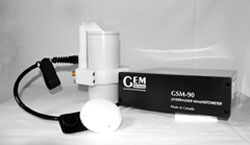
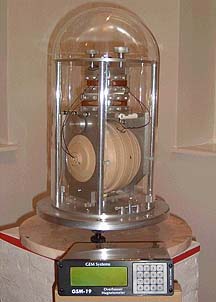
However, a key trend to watch for is the replacement of multiple instrumentation packages (i.e. fluxgate and total magnetic intensity systems) with new, single instruments, such as the Overhauser or Potassium Suspended dIdD (delta Inclination delta Declination) system from GEM.
The Suspended dIdD simplifies the set-up of magnetic observatory installations by eliminating the need for fluxgate magnetometers and thermal insulating structures. In addition, the new system minimizes ongoing system calibrations, which, in turn, frees personnel to concentrate on more essential tasks, such as interpreting and understanding data.
On the platform side, reknowned GEM customers, such as the British Geologic Survey (BGS), are currently making their in-house developed software acquisition platform available globally. In addition, large organizations, such as the Australian Geoscience Organization (formerly AGSO) and the United States Geological Survey (USGS) are standardizing on GEM technologies.
Applying Advanced Magnetic Technologies
With new, highly stable instruments available, it is an ideal time to take advantage of GEM’s proven line of observatory magnetometers.
The company’s EUROMAG scalar magnetometer is a global standard for total field measurements based on long-term stability and sensitivity. An example of this type of installation is at https://www.intermagnet.org/imos/imoasp_e.html.
The world’s newest observatory at Tihany, Hungary is based on the recently developed Suspended dIdD. This suspended system eliminates the need for fluxgate magnetometers in observatories, and saves costs of buying and configuring multiple types of instrumentation.
Product characteristics are as follows:
EUROMAG delivers an economical stationary total field magnetometer system with excellent long-term monitoring characteristics.
Overhauser (fast and very fast versions) provide excellent long-term monitoring characteristics for both stationary and portable applications.
dIdD Suspended Vector fast-cycling and standard-cycling vector magnetometer for continuous monitoring of the earth’s magnetic field.
Observatory Magnetometers Brochure
GEM User Links
Below is a partial list of Magnetic Observatories that have standardized on or implemented GEM Systems. If you require additional information on a particular observatory listed (or not listed) here, please contact GEM.
Intermagnet Global network of observatories, monitoring the Earth’s magnetic field.
IAGA International Association of Geomagnetism and Aeronomy, is the premier international scientific association promoting the study of terrestrial and planetary magnetism and space physics
Canada Canadian National Geomagnetic Program. Standardized on GEM.
Finland Numivarji Observatory,
Germany Niemegk and Munich Observatories.
Hungary Tihany Observatory.
Japan Kakioka Observatory and others.
South Africa Hermanus Observatory.
United Kingdom has Multiple observatories, British Geological Survey including Eskdalemuir Observatory (Scotland).
USA Multiple observatories. USGS Geomagnetism Program.
The USGS and many other have standardized on GEM Systems’ Solutions.
CONRAD Geomagnetic Observatory in Austria
BACK


REQUEST A CALLBACK
If you would like to receive a callback from GEM Systems.

NEWS and EVENTS