







Supergrad Gradiometers

Increasingly, researchers are looking in to the applications of magnetics alone or in combination with seismic or radon measurements as means of monitoring geohazards (i.e. for earthquake prediction). It also has military applications.

GEM’s solution for these types of installations is the Potassium SuperGrad. This special gradiometer is a system based on the Optically Pumped Potassium instrument – a unique technology that was developed in response to the United States Geological Survey’s need for an ultra-high sensitivity magnetic gradiometer.
GeoHazard Applications
The SuperGrad is a three axis total field magnetometer/gradiometer of choice for customers who require:
- Superior gradiometer sensitivity
- High absolute accuracy
- Almost no orientation errors
- Reliability
The SuperGrad is currently being employed for earthquake studies in the vicinity of the Dead Sea Rift, Israel in combination with an integrated radon measuring system. The Integrated SuperGrad/Radon (ISGR) system was developed in conjunction with ISORAD. The Geological Survey of Israel and the Israel Survey have also been key participants in the realization of an initial working and tested product.
GSMP-20 Benefits
Main benefits of the SuperGrad include:
Highest sensitivity of any gradiometer available commercially. The measurement is done to 11 digits with the resolution of 1fT (0.001pT or 0.000001nT). Two least significant digits of this computation are not very significant but serve to eliminate counter uncertainty. The average period is determined by the least squares fit of the chain of zero crossings measurements. The basic sampling interval is 50 msec and the averaging can go from 50 msec to as long as 1 sec with 20 updatings per second.
High absolute accuracy ensures that critical high sensitivity measurements are acquired to the highest quality. The variance between sensors is only +/- 0.1 nT.
Insensitivity to orientation means that the system is easy to set up and operate. The nuclear properties of Optically Pumped Potassium methods ensure that there is virtually zero heading error.
Reliability. GEM’s Optically Pumped Potassium instrumentation is a proven technology that has been migrated seamlessly in to the SuperGrad geophysical instrumentation package.
The SuperGrad also takes advantage of many of the benefits of the Potassium system as described in the Potassium product pages.
Understanding the GSMP-20S3 Measuring Sequence
The SuperGrad is an extended version of GEM’s leading Potassium technology. The SuperGrad measurement process is similar to that of other GEM Optically Pumped Potassium systems with the exception that recording encompasses measurements using three sensors:
Alkali vapor optically pumped magnetometers use alkali metals including Cesium, Potassium or Rubidium. The cell containing the metal must be continuously heated to approximately 45 to 55 degrees Celsius to render the metal in gaseous form.
These magnetometers operate on virtually the same principle as illustrated, in part, below.
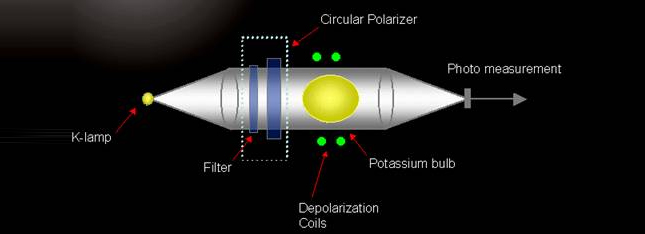
Potassium alkali-vapour magnetometer
- A glass vapour cell containing gaseous metal is exposed (or pumped) by light of very specific wavelength – an effect called light polarization. The frequency of light is specifically selected and circularly polarized for each element (i.e. the D1 spectral line) to shift electrons from the ground level 2 to the excited metastable state 3 (Figure below).
- Electrons at level 3 are not stable, and they spontaneously decay to both energy levels 1 and 2. Eventually, the level 1 is fully populated (i.e. level 2 is depleted). When this happens, the absorption of polarizing light stops and the vapour cell becomes more transparent.
- This is when RF depolarization comes into play. RF power corresponding to the energy difference between levels 1 and 2 is applied to the cell to move electrons from level 1 back to level 2 (and the cell becomes opaque again). The frequency of the RF field required to repopulate level 2 varies with the ambient magnetic field and is called Larmor frequency.
- Depolarization by a circular magnetic field at the Larmor frequency will rebalance populations of the two ground levels and the vapour cell will start absorbing more of the polarizing light. The effect of polarization and depolarization is that light intensity becomes modulated by the RF frequency. By detecting light modulation and measuring the frequency, we can obtain a value of the magnetic field.
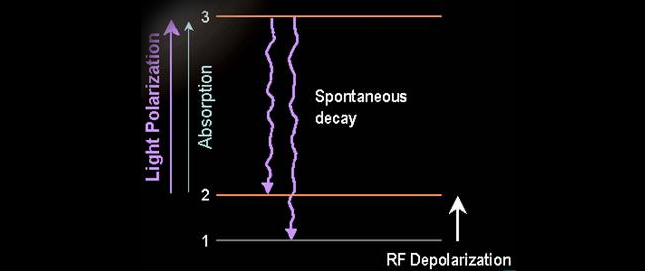 Quantum mechanics of alkali vapour system
For More Information
For more information on Potassium technologies, please refer to the technical papers on this site. More information and Specifications for the SuperGrad are provided in the GEM SuperGradiometer Brochure.
- SuperGrad – FAQ: Using Gradiometric Monitoring
- SuperGrad – FAQ: The SuperGradiometer System
- SuperGrad – FAQ: Implementation of a SuperGrad
- SuperGrad – FAQ: Integrating Radon Measurements with SuperGrad
- SuperGrad – Installation at the CONRAD Earth Observatory in Austria VIDEO
Observatory users may also be interested in the Suspended dIdD vector magnetometer which can be accessed via the Vector Magnetometers product page.
If you would like information specific to your work, please visit our Quotations area and submit a Request for Quotation. We would be delighted to provide you with a no-obligation quote suited to your exact needs.
BACK

REQUEST A CALLBACK
If you would like to receive a callback from GEM Systems.

NEWS and EVENTS