







GEM GSMP Potassium Magnetometer for High Precision and Accuracy
Mineral Exploration, UXO, Archaeology
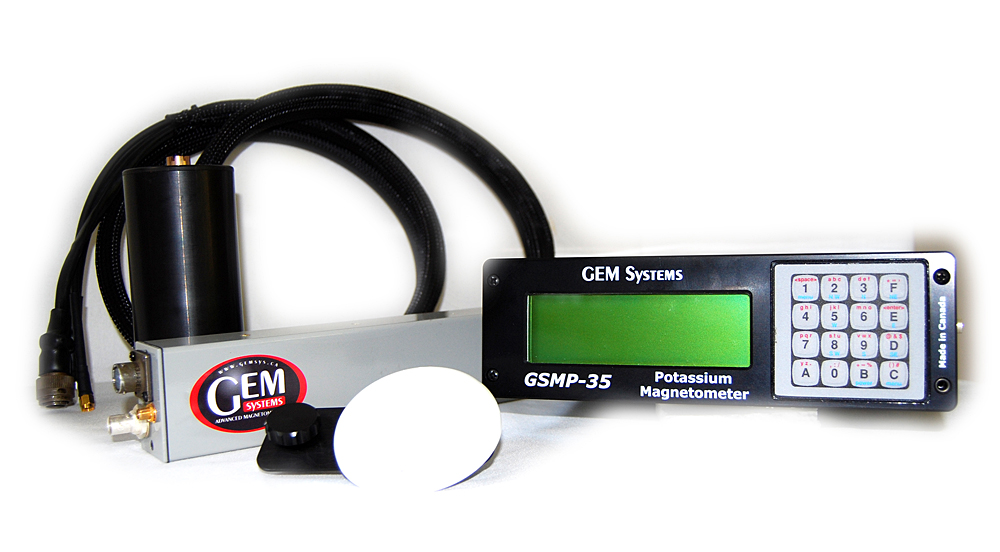
The most sensitive, commercially available magnetometer is the Potassium magnetometer/gradiometer system. The GSMP-35/25 ground system is the highest sensitivity with the greatest absolute accuracy instrument for subsurface investigations in numerous fields, including, but not limited to, mineral prospecting and exploration, oil & gas exploration, UXO detection and discrimination, and environmental & engineering.
The GSMP series of magnetometers have the absolute maximum in data quality – exceeding that of conventional Cesium Magnetometer devices by an order-of-magnitude, or more! Data quality is driven by sensitivity, minimal heading error, high absolute accuracy, no microphony, and overall design. Unlike its cesium magnetometer cousin, Potassium offers a thin spectral line of operation – meaning that there are fewer drop-outs and errors during surveying. In the event of a drop-out, it is easy to spot in Potassium magnetometers unlike cesium magnetometers.
Detailed-High Sensitivity Mapping
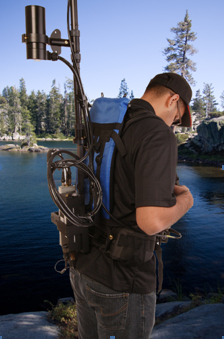
Many subsurface targets have subtle signals that can only be detected with an ultra-sensitive magnetometer/gradiometer. These targets include gold deposits with subtle shear and fracture zones, archeaological artifacts, and subtle anomalies.
High data quality is assured through the GSMP-35 magnetometer’s ultra-high sensitivity (0.0002 nT @ 1Hz). Ultra-sensitivity gives you the confidence to detect and characterize hidden targets with precision and confidence. It is a new era in magnetometry with the GSMP.
Fast-Sampling
The Potassium magnetometer has a maximum sampling frequency of 1000 Hz (along with other, selectable sampling rates). This sampling gives amazing functionality for performing automated surveys. These are surveys in which clients use various platforms, such as all-terrain-vehicles, sleds, bicycles, etc., to make measurements at a relatively rapid speed – 5 to 10 km per hour.
This kind of coverage gives a huge advantage for large (and smaller) surveys – offering very efficient surveying at minimal cost.
Gradiometer mode and “High Field” Operationg Modes
Because of its design and physics, the GSMP-35/25 can be used in several different “flavours”. In magnetometer mode, the system comes with a single ultra-high sensitivity sensor and electronics. This configuration is doubled up for gradiometers – which unlike other products on the market – offer true simultaneous readings for highly accurate gradient maps and interpretations.
The system is also available as a “high-fields” magnetometer/gradiometer system, capable of recording extremely high fields that occur over iron deposits and potentially within city limits where noise is pervasive. This version is referred to as the “Iron-Mag” and is unique to GEM.
Other Key Features and Benefits
The Potassium magnetometer is a fully-featured geophysical instrument with many time- and cost-saving additions. These include versatile import, display, navigation, surveying, sampling, and more. All of these functions can be accessed either by the system console or through a designated link to your Personal Computer.
The design of these capabilities ensures minimal time to set up, run a survey, and obtain results. The system is also equipped with an easy-to read display with specific settings for presenting real-time data on the console or PC.
For navigation, the Potassium magnetometer is equipped with one of the most powerful
navigation engines available with Waypoint and other functionality that ensures that costly errors are avoided and that the data are accurately positioned for the optimal results.
A high-capacity memory is included so that even the most densely sampled data can be recorded and stored successfully. Memory is designed to provide multiple days of storage for back-up and timely downloading.
Integrated GPS
Integrated GPS is a huge development. Not only do our GPS technologies tell you where you have been, but they tell you where you need to go. This allows for highly accurate readings via ‘Waypoint Programming’ as well as accurate time synchronization for base station corrections.
With Waypoints, you design your survey on your personal computer and import the stations with ease into the magnetometer console. Then, the system will guide you to each Waypoint where a reading is to be made. With ‘Walking’ mode, you have a nearly continuous record of GPS-referenced data points – a major advantage in surveying because you save time in the field and it eliminates the possibility of positioning mistakes.
Walking VLF
Walking VLF is also available in combination with a Potassium magnetometer. Additionally, please see the Airborne VLF brochure from GEM for alternative Potassium combinations.
Advantages of utilising Potassium Vapour Magnetometers
The GSMP-35/25 uses a cell containing Potassium vapour. Electron precession frequency is obtained from a single spectral line allowing for highest sensitivity and absolute accuracy in comparison with other competing products. Potassium does not “wander” across spectra as cesium does, which results in minimal “drop-outs” and overall better quality data.
Specifications
GSMP-35
Sensitivity: 0.0002 nT @ 1 Hz
Resolution: 0.0001 nT
Absolute Accuracy: +/- 0.05 nT
Dynamic Range: 15,000 to 120,000 nT, (250,000 optional)
Gradient Tolerance: 50,000 nT/m
Sampling Rate: 1, 2, 5, 10, 20, 100 (optional), 1000 (optional) Hz
Operating Temperature: -40°C to +55°C
GSMP-25
Sensitivity: 0.022nT @ 1Hz
Resolution: 0.0001 nT
Absolute Accuracy: +/- 0.05 nT
Dynamic Range: 15,000 to 120,000 nT, (250,000 optional)
Gradient Tolerance: 50,000 nT/m
Sampling Rate: 1, 2, 5, 10, 20, 100 (optional), 1000 (optional) Hz
Operating Temperature: -40°C to +55°C

To learn more about GEM’s Potassium Magnetometer system, or to obtain a quote, contact GEM.
Our World is Magnetics!


REQUEST A CALLBACK
If you would like to receive a callback from GEM Systems.
