







Potassium Vapour Magnetometers – A Short Summary (Part 1)
By Dr. Ivan Hrvoic, President, GEM Systems, Inc.
Introduction
This paper is intended to provide a short overview for professionals and students who are interested in learning more about potassium magnetometers and their differences from other types of magnetometers available today. Key topics include:
- Physical overview of quantum magnetometers
- Optical pumping of alkali vapours
- Broad line Cesium, Rubidium and Helium versus narrow line Potassium
- Standard and super-resolution K-sensors and systems
- Future directions
This paper is based on more than 10 years of research and development into the topic by GEM Systems, Inc. as well as other published results from the scientific community.
Physical Overview of Quantum Magnetometers
Some subatomic particles, in particular electronic and nuclei of some elements process spin; rotation and they have an accompanying mechanical moment.
P= I h/2Ï€ I = spin number, half integer h = Plank’s constant
Since the particles with spin have charge, they also possess a magnetic moment related to the mechanical by
µ = γ pγ = gyromagnetic constant
In an applied magnetic field, such as the Earth’s, magnetic moments can only assume discrete orientations governed by the spin number, I. Coupling energy between the particle and the magnetic field is

E = -µ H = µ H cos this is a scalar product of the two vectors
There can be only 2 I + 1 permitted states. For I = ½ for electrons and protons there are only 2 allowed energy states, permitted angles between the two vectors are + 450 . In an assembly of spins the distribution of populations of the two levels is regulated by
e-E/kT = e µH/kT
so the higher energy level is less populated. The result is a slight paramagnetism of the assembly of particles with spin due to spin and the magnetic moment.
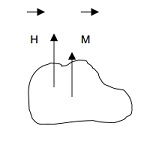
Individual spinning particles precess around the magnetic field with the angular frequency
ωo = γH
where γ is a gyromagnetic constant. Since there are many particles spinning incoherently, there is no macroscopic effort of it i.e. the magnetization due to spins appear static.
However, if one applies a rotating magnetic field of the angular frequency ωo in the plane perpendicular to the magnetic field, the vector of magnetization will be deflected off the direction of magnetic field and will precess around it with the same frequency.
Precessing or rotating magnetization will induce a voltage in a coil suitably wound around the assembly of spins. Frequency of the detected voltage is proportional to the applied field to a great precision.
In a weak magnetic field such as Earth’s, the induced voltage is far too small for direct detection. Instead various means are applied in order to polarize the sensor spin assembly i.e. to increase the macroscopic magnetization due to spins.
There are three principally different groups of quantum magnetometers:
- Proton magnetometers use strong DC magnetic fields to increase protons magnetization.
- Overhauser effect is based on a mixture of electrons and protons. Electrons are manipulated to transfer their polarization to protons.
- Some alkali metals and He 3 and 4 can be “optically pumped” to increase the magnetization due to their electron spins.
We will be concerned only with the third group.
BACK
 Categories
- All (138)
- General Category (23)
- Magnetometers (29)
- News & Events (101)
 Recent Posts
- EAGE NSG, Sept 20-24, Greece
- EAGE, June 8 to 11, Aberdeen, UK
- PDAC 2026 March 1 – 4th, Toronto
- Merry Xmas: Office Closed Dec 24 – Jan 4
- AGU2025, Dec 15-19, New Orleans
- EAGE NSG, 7-11 September, Naples
- Office closed July 1st, 2025
- EAGE 2025, June 2 – 5, Toulouse
- PDAC March 2 – 5, 2025
- 2024 Holiday Office Hours
 RSS Feeds
 Archives
- August 2026
- May 2026
- February 2026
- December 2025
- September 2025
- July 2025
- May 2025
- January 2025
- December 2024
- October 2024
- June 2024
- April 2024
- February 2024
- January 2024
- December 2023
- October 2023
- June 2023
- February 2023
- December 2022
- October 2022
- August 2022
- June 2022
- May 2022
- December 2021
- November 2021
- October 2021
- December 2020
- January 2020
- December 2019
- October 2019
- September 2019
- August 2019
- May 2019
- March 2019
- February 2019
- January 2019
- December 2018
- November 2018
- October 2018
- September 2018
- August 2018
- July 2018
- May 2018
- April 2018
- February 2018
- January 2018
- December 2017
- October 2017
- September 2017
- August 2017
- June 2017
- May 2017
- April 2017
- February 2017
- January 2017
- December 2016
- September 2016
- August 2016
- July 2016
- June 2016
- March 2016
- February 2016
- December 2015
- October 2015
- May 2015
- April 2015
- March 2015
- February 2015
- January 2015
- December 2014
- November 2014
- October 2014
- September 2014
- August 2014
- July 2014
- June 2014
- May 2014
- April 2014
- March 2014